BMW and Mercedes-Benz Radiator Leaks and Failure: Symptoms, Diagnosis and Replacement
What the radiator does, and why it fails
The radiator is where engine coolant gives up its heat. Hot coolant from the engine runs through thin aluminum tubes in the core, and air from driving and the electric cooling fan carries the heat away. The thermostat decides how much coolant goes through the radiator, and the water pump moves it.
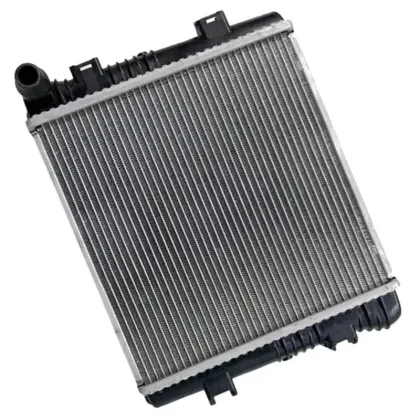
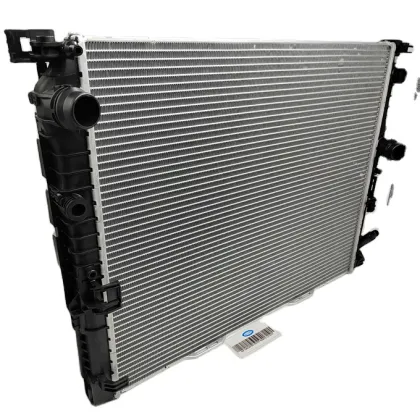
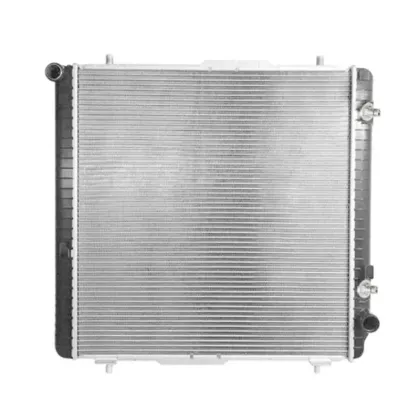
Most modern BMW and Mercedes-Benz radiators use an aluminum core with plastic end tanks crimped onto it with a seal. Heat cycles make the plastic brittle over the years, so the most common failures are a crack in an end tank, a leak at the seam where tank meets core, or a broken hose neck or mounting tab. The core can also clog inside with deposits, or outside with dirt and debris, and fins can corrode. Any of these reduces cooling capacity.
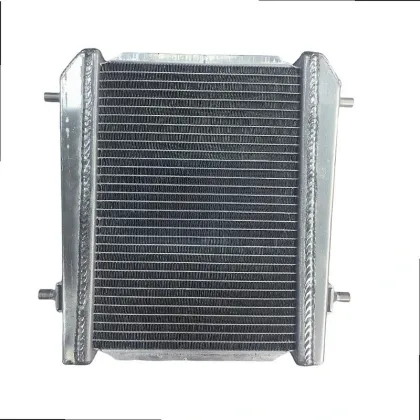
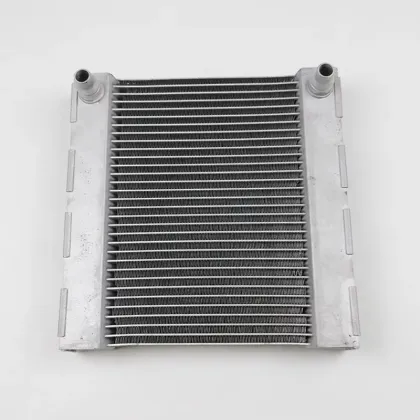
High-output engines add auxiliary radiators. These are smaller coolant radiators, usually in the front corners of the car near the main cooling pack, that add capacity for hard driving. They sit low and close to the road, so they take stone chips and road salt, and they can leak just like the main radiator.
Symptoms of a leaking or failing radiator
- The coolant level in the expansion tank keeps dropping, or a low coolant warning comes on.
- Drips or a puddle under the front of the car, or dried white, green, pink or blue residue on the radiator, its end tanks or the hoses.
- A sweet coolant smell, or steam from the front of the engine bay after a drive.
- The temperature gauge runs higher than usual, especially in traffic, on hills or in hot weather, or an engine temperature warning appears.
- Reduced power, which some cars use to protect an overheating engine.
- Poor heat from the vents, because a low coolant level leaves air in the heater core.
If the temperature warning comes on, stop as soon as it is safe and switch off. Driving an overheated engine can warp the cylinder head or damage the head gasket.
How to diagnose it
- Let the engine cool completely. The cooling system is pressurized, and opening the expansion tank on a hot engine can spray scalding coolant.
- Check the coolant level when cold and note it, so you can tell how fast it is dropping.
- Inspect the radiator with a flashlight. Look along the seams of both plastic end tanks, at the hose necks and at the bottom edge of the core. Coolant residue usually traces back to the leak.
- Pressure-test the system with a cooling system tester and adapter for your expansion tank. Hold the pressure your repair information specifies and watch for drips or a falling gauge. Small leaks often appear only under pressure.
- Check auxiliary radiators too. On many AMG and BMW M models they sit behind the front bumper corners, and a leak there may only show as residue on the bumper liner.
- Rule out the parts that mimic a radiator problem: a stuck thermostat, a weak water pump, a cooling fan that does not run, or a leaking hose or expansion tank.
- If the engine has overheated, or coolant is lost with no visible leak, have the coolant tested for combustion gases. That points to a head gasket problem rather than the radiator.
Our guides to the BMW water pump and the BMW electric cooling fan cover two of the most common lookalikes.
Matching the part: OEM number and VIN
Radiators differ by engine, transmission, equipment and build date, and the main and auxiliary radiators are different parts. Read the number on your old radiator if you can, and check it against your VIN in a BMW or Mercedes-Benz parts catalog before you order. The numbers we list:
- 17118484638 (17 11 8 484 638) is the front radiator listed for the G30 5 Series (530i, 530e, 540i and xDrive versions), the G12 740i, 740e and 745e, the G32 640i xDrive Gran Turismo and the 840i in coupe, convertible and Gran Coupe form.
- 17118743664 is a radiator listed for the 2017–2019 G30 530i and 540i, the G12 740i and the G32 640i xDrive Gran Turismo. It overlaps with the number above, so check by VIN which one your car uses.
- 17118095285 is the auxiliary radiator listed for the 2021–2025 M3 and M4 and the 2023–2024 M2 with the 3.0 L six-cylinder. It mounts in the front bumper area; check by VIN how many your car uses.
- 4615000102 (A 461 500 01 02) is the main radiator listed for the 2012–2015 Mercedes-Benz G550 with the 5.5 L V8.
- 0995005903 (A 099 500 59 03) is an auxiliary radiator listed for the C63 AMG and AMG GT family of 2016–2021, the GLE63 and GLS63 AMG of 2016–2019, and the GLE53, GLE580 and GLS580 mild hybrids.
- 0995003203 (A 099 500 32 03) is an auxiliary radiator listed for the E63 AMG, CLS63 AMG, G63, G65 and GL63 AMG of about 2012–2018 and the 2014–2019 CLA45 AMG.
Some AMG models use two auxiliary radiators. Each product page has a fitment table; see all radiators, or the BMW and Mercedes-Benz catalogs.
Replacement overview, difficulty and safety
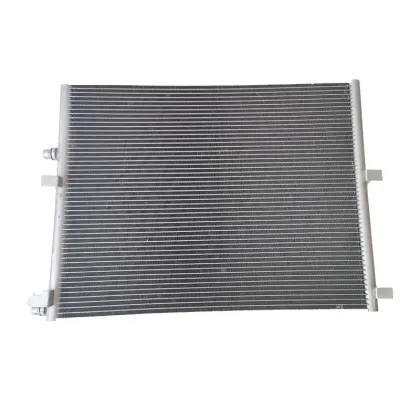
Difficulty: intermediate to advanced. On most of these cars the front bumper cover or the cooling pack has to come apart, and on some the A/C condenser and fan are in the way. Auxiliary radiators are often easier to reach once the bumper cover or wheel liner is off.
- Work on a cold engine, and disconnect the battery before you unplug fans or sensors.
- Catch the coolant in a clean pan. It is toxic to people and animals, so take it to a recycling point that accepts it.
- Do not open the A/C system yourself. If the condenser has to be disconnected, the refrigerant must be recovered by a shop with the right equipment.
- Fit new O-rings and clips where the hoses connect. Old plastic clips and quick-connectors often break during removal.
- Refill with the coolant type the manufacturer specifies, mixed to the correct ratio. Do not mix coolant types.
- Bleed the system with the factory procedure. Many current BMWs bleed through the electric coolant pump with the ignition on, and trapped air causes overheating and false warnings.
- Run the engine to temperature, watch the gauge, check for leaks, and re-check the level once the engine is cold.
Repair or replace?
A crack in a plastic end tank or a leak at the crimped seam is not a reliable repair on these radiators, and leak-stop additives can block small passages in the core and heater. Replacing the radiator is the normal fix. If the radiator is the original part on a car with many miles, the expansion tank, hoses and thermostat are often near the end of their life too, and doing them while the system is drained saves a second job.
The radiators we list are aftermarket replacements matched to the OEM numbers shown, not genuine BMW or Mercedes-Benz parts. We do not state warranty or stock terms on this page; ask us to confirm them for a listing before you order.