BMW Electric Cooling Fan (Radiator and A/C Condenser Fan) Not Working: Symptoms and Replacement
What the electric fan does on your BMW
At highway speed the air rushing through the grille is enough to cool the radiator and the A/C condenser in front of it. At low speed, in traffic or at idle, there is not enough natural airflow, and an electric fan behind the radiator pulls air through both. The engine computer (DME) controls the fan speed according to coolant temperature, A/C refrigerant pressure and other inputs, so the fan can run anywhere from a gentle low speed to full blast.
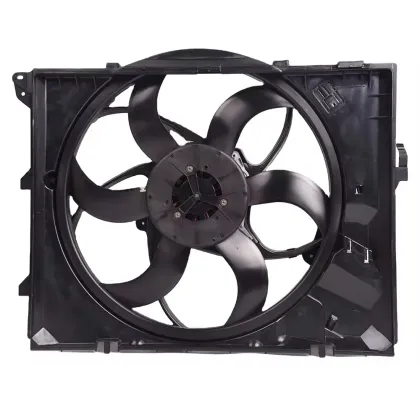
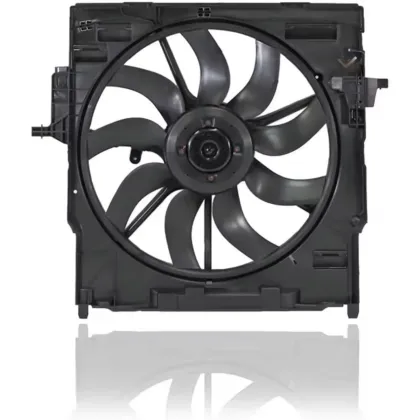
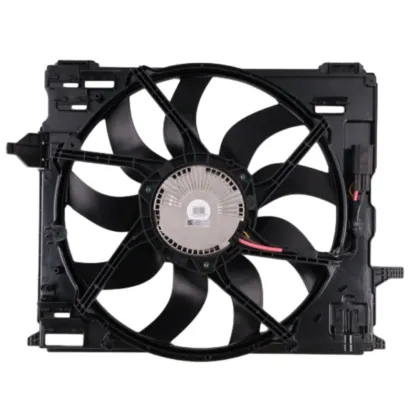
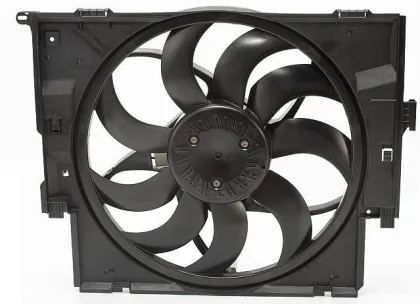
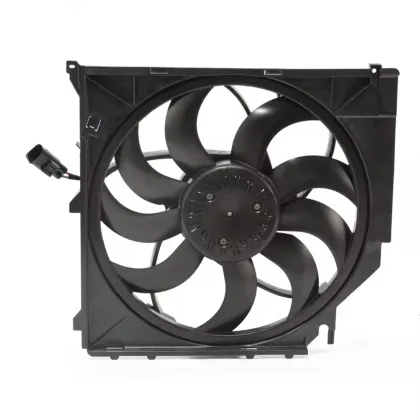
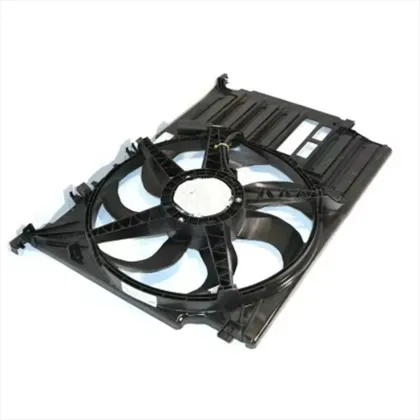
The fans we carry for BMW are the main electric fan assemblies: a motor, a blade and the shroud that mounts to the radiator, usually sold as one unit. They are not the small auxiliary pusher fans that older BMWs such as the E46 and E39 had in front of the condenser, alongside an engine-driven viscous fan. On the E90-generation and later cars listed below, this one electric assembly handles both engine cooling and condenser airflow, so its failure affects both. If you are not sure which layout your car has, look behind the radiator or check the parts diagram for your VIN.
Most of these fans have control electronics built into the motor housing. The DME sends a speed request and the fan’s own module drives the motor. That module is exposed to heat and moisture, and it is as common a failure point as the motor itself.
Symptoms of a failing cooling fan
- The temperature gauge or coolant temperature display climbs in stop-and-go traffic or at idle, then drops once you are moving again.
- The A/C blows cold on the highway but warm or only slightly cool at a stop or in slow traffic.
- A coolant temperature warning or reduced-power message in hot weather or after idling.
- The fan runs at full speed constantly, or keeps running at high speed long after the engine is off, which can drain the battery.
- A grinding, rattling or whining noise from behind the radiator, or a fan that wobbles.
- Visible damage: cracked blades or a broken shroud.
It is normal for many BMW fans to keep running for a few minutes after shutdown when the engine is hot. A fan that runs much longer than that, or that runs at full speed from a cold start, points to a fault.
How to diagnose it
- Safety first. The fan can start on its own with the ignition off and the key out, especially right after a drive. Keep hands, tools, hair and loose clothing away from the blades, and disconnect the battery or unplug the fan before you reach near it. Let the cooling system cool before you open anything; it is pressurized and hot coolant can scald.
- Check the coolant level in the expansion tank when cold. Low coolant causes overheating that has nothing to do with the fan.
- With the engine warmed up and the A/C on, watch whether the fan runs. On most of these cars it should run at least at low speed with the A/C on in warm weather. A fan that never runs while the temperature rises is suspect.
- Read the fault memory with a BMW-capable scan tool. The DME stores codes for the electric fan and its control signal, and many tools can command the fan to run at set speeds as a test.
- Check the fan’s high-current fuse and the heavy power and ground connections, and look for corrosion or melted plastic at the connector.
- If power, ground and the control signal reach the fan and it still does not run, or runs only at full speed, the fan assembly is faulty.
Also consider the thermostat and the water pump. A stuck thermostat or a weak pump can cause overheating that looks like a fan problem; see our BMW water pump guide.
Matching the fan: OEM number and VIN
BMW fans differ by model, engine, wattage and options. A higher-wattage fan draws more current, and the wiring and fuse are sized for the original, so do not substitute a different number to get more airflow. Read the number on your old fan’s shroud or motor and confirm it by VIN. The BMW fans we carry:
- 17117590699 (17 11 7 590 699) is listed for N52 six-cylinder cars: the 128i, E90–E93 323i, 325i, 328i and 330i (2006–2013) and the Z4 sDrive30i (2009–2011).
- 17428641964 is listed for 2012–2016 F30/F31/F34 3 Series (328i, 335i, ActiveHybrid 3), the 228i and M235i, and the 428i and 435i.
- 17427634471 is listed for the F15 X5 (2014–2018, sDrive35i, xDrive35i, xDrive35d, xDrive40e) and F16 X6 35i (2015–2019).
- 17112284887 is listed for the F80 M3 (2015–2018), F82/F83 M4 (2015–2020) and M2 Competition (2019–2021).
- 17113442089 is the fan housing with electric fan for the E83 X3 2.5i, 3.0i and 3.0si (2004–2010).
- 17427617610 is a fan with housing for the 2020–2022 X1 sDrive28i (F48).
See all BMW cooling and condenser fans or the BMW catalog. Each product page lists the models, years and body codes.
Replacement overview, difficulty and safety
Difficulty: intermediate. On many BMWs the fan and shroud come out from below or from above after removing the air intake ducting, the upper radiator support covers and sometimes the lower splash shield. On some models the radiator or other parts must be moved forward or loosened to get the shroud out. Check the procedure for your model before you start; some jobs involve draining coolant if hoses are in the way.
- Disconnect the battery before unplugging the fan. Never rely on the ignition being off to keep the fan still.
- Work on a cold engine. The radiator and hoses get hot enough to burn.
- Note how the shroud locates on the radiator, and transfer any clips, seals or brackets the new unit needs.
- Make sure the connector is clean, dry and fully latched. Corrosion here is a common cause of fan faults.
- Afterward, run the engine to temperature with the A/C on, confirm the fan runs, and clear any stored codes.
If the engine overheated badly before the fan was replaced, have the cooling system checked for leaks or head gasket damage before relying on the car.
Repair or replace the whole assembly?
On most of these BMWs the fan motor, its control module, the blade and the shroud are sold together as one assembly, and the motor is not meant to be serviced. Replacing the complete assembly is the normal repair. The fans in our catalog are aftermarket replacements listed against the BMW numbers shown, not genuine BMW parts, so match the OEM number exactly.