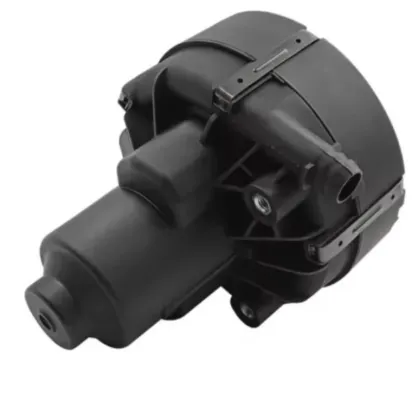
Audi Secondary Air Injection Pump Failure: P0411 and Related Codes, Noise and Failed Emissions
What the secondary air system does
A catalytic converter does little until it is hot. To shorten that cold phase, many Audi gasoline engines use secondary air injection. For a short time after a cold start, an electric pump blows fresh air into the exhaust ports just behind the exhaust valves. The extra oxygen burns off unburned fuel in the exhaust, which cuts emissions and heats the converter faster.
The system has the pump, hoses, one combination valve (combi valve) per bank that opens to let air in and stops exhaust from flowing back, a solenoid or pressure control for those valves, and passages in the cylinder head. Newer engines also have a pressure sensor. The pump only runs at cold starts, usually for around a minute or so depending on the engine and coolant temperature. Some engines also switch it on briefly at idle after later starts so the system can test itself.
Symptoms of secondary air problems
- Check engine light, usually after a cold start, with a secondary air code.
- A loud whine, buzz, grinding or rattle from the pump for the first minute after a cold start. A worn pump bearing gets louder over time.
- Silence when the pump should be running. A pump that used to be audible on cold mornings and no longer is may have failed.
- A failed emissions inspection because the secondary air readiness monitor will not complete or a code is stored.
- Water or corrosion in the pump, its outlet hose or its connector.
The car usually drives normally. Because the system only matters during warm-up, a dead pump often goes unnoticed until the light comes on or the car fails an inspection.
Fault codes and how to diagnose
The generic codes you are most likely to see are P0411 (secondary air injection system incorrect flow detected), P0491 and P0492 (secondary air injection system insufficient flow, Bank 1 and Bank 2), P0410 (secondary air injection system), P0418 (pump relay or control circuit) and, on newer engines, P2440 and P2442 (switching valve stuck open, Bank 1 and Bank 2). Many of these do not mean the pump has failed. Work through the system:
- Safety first. Work on a cold engine, keep clear of the fan and belts, and disconnect the battery before you unplug or replace electrical parts.
- Listen to a true cold start, or use a VW/Audi-capable scan tool to run the pump with an output test or the secondary air test. A pump that runs and moves air is probably not the problem.
- If the pump is silent, check its fuse, relay and connector before you condemn it.
- Pull the hose off the pump outlet. Water, rust or soot inside suggests a leaking combi valve has let exhaust and moisture back into the pump. If you replace a water-damaged pump, replace the faulty combi valve as well, or the new pump may fail the same way.
- Check the hoses and pipes between the pump and the combi valves for cracks and loose joints, and check the vacuum lines and solenoid that operate the valves.
- If the pump and valves work but P0491 and P0492 return, the air passages in the cylinder heads may be blocked with carbon, a known issue on some Audi V6 and V8 engines. Audi has issued service information for some 3.0 L and 3.2 L V6 models; a dealer can check by VIN whether it applies to your car.
Matching the pump: OEM number and VIN
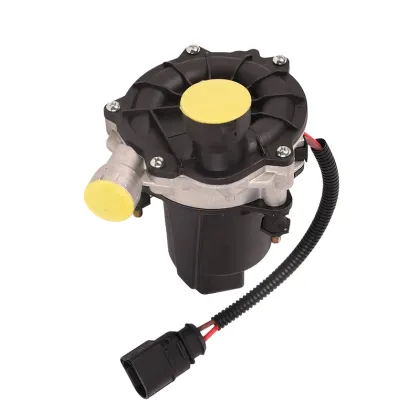
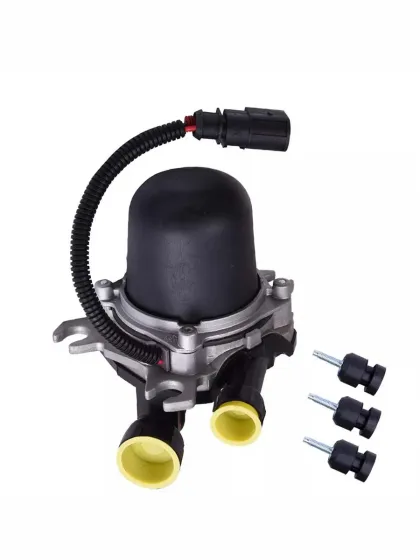
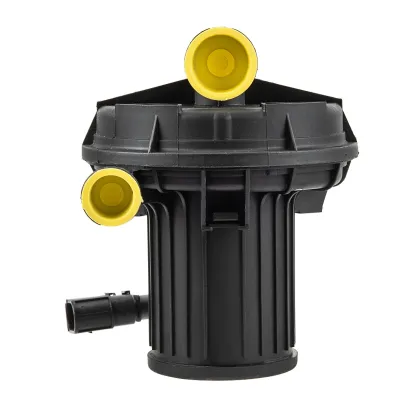
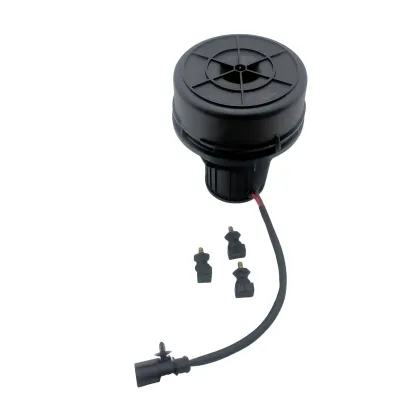
Audi has used several different pumps, and they differ in mounting, outlet and connector. Compare the number on your old pump and confirm it against your VIN before ordering.
- 06A959253E (also written 06A 959 253 E; also sold as 06A959253B) is listed for many early-2000s gasoline engines: the 2002–2006 A4 with the 1.8 L turbo and 3.0 L V6, the 2000–2004 A6, the 2004–2009 A8 4.2 and 6.0, the 2007–2010 Q7 and the 2004–2006 TT 3.2.
- 07K959253A (also 07K131333A) is listed for the 2009–2013 A3 with the 2.0 L gasoline engine and the 2013–2015 RS5 with the 4.2 L V8.
- 079959231G is listed for the 3.0 L V6 S4 and S5 and the 4.0 L V8 A8, S6, S7, S8 and RS7 of roughly 2012–2018, and for some 2.0 L A4 and A5 models.
- 06E906601A (also 4H0131017D) is listed for the 2013–2018 A8 and A8 L with the 3.0 L supercharged V6.
Mercedes-Benz V6 and V8 models of the same era use a similar system; 0001405185 is listed for many 2005–2015 C-, E-, ML-, S-Class and other models. See all air injection pumps, the Audi catalog and the Mercedes-Benz catalog.
Replacement overview and difficulty
Difficulty: beginner to intermediate for the pump itself. On many cars it sits low at the front of the engine bay or behind a wheel-arch liner and is held by a bracket, two hoses and one connector. Combi valves are usually mounted on the engine and can be harder to reach on V engines. Cleaning carbon from cylinder head passages is a workshop job.
- Disconnect the battery and let the engine cool.
- Note how the hoses and harness are routed, then remove the pump with its bracket.
- Check the intake hose or filter for the pump, and replace cracked hoses and perished rubber mounts while you are there.
- Fit the new pump, reconnect and clear the codes. Run an output test or the secondary air test with a scan tool if you can, or let the car sit cold overnight and listen at the next start.
- Drive normally for a few days so the readiness monitor can complete before an emissions inspection.
Should you replace it?
If the pump is noisy, seized or full of water, replacement is the fix; these pumps are not usually repaired. If it runs and moves air, look at the valves, hoses and head passages instead. Removing or disabling emissions equipment on a road car is not a legal fix in the US, and the readiness monitor would not complete. The pumps listed here are aftermarket replacements for the OEM numbers shown, not genuine Audi or Mercedes-Benz parts.