BMW Oil Cooler Leak: Oil Filter Housing, Engine Oil Cooler and Transmission Cooler Symptoms
Three different leaks that get called an oil cooler leak
When a BMW owner searches for an oil cooler leak, the problem is usually one of three parts. They are different repairs with different part numbers, so it is worth sorting out which one you have before you order anything.
- The oil filter housing and its gaskets. On the N20, N26, N51, N52, N54, N55 and related engines, the oil filter housing bolts to the side of the engine and routes oil to and from the oil cooler. The rubber gaskets between the housing and the engine, and between the housing and the cooler, harden with age and are a very common source of oil leaks. Usually the gaskets are replaced, not the housing.
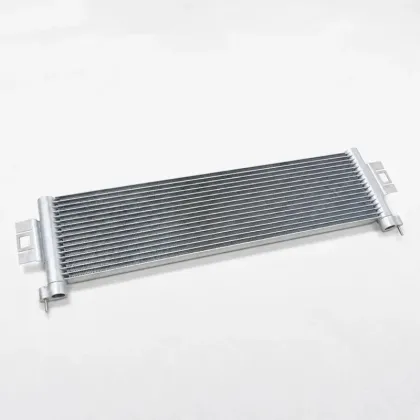
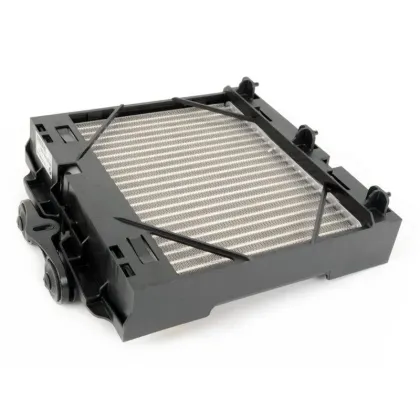
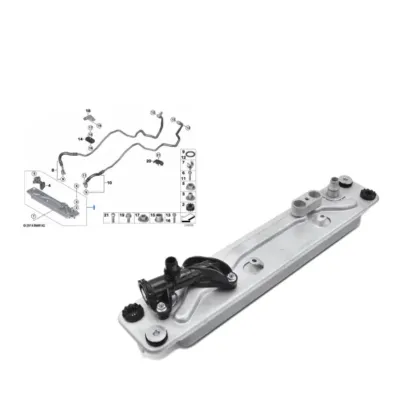
- The external engine oil cooler. Some models, mainly larger six- and eight-cylinder cars and M cars, have a finned, air-cooled oil cooler in the front of the car, fed by oil lines. On the F10 5 Series it sits in the right side of the front bumper; on the S58 engine of the G-series M3, M4 and M2 it sits low under the front of the car. These coolers leak from stone damage, corrosion and aging line seals.
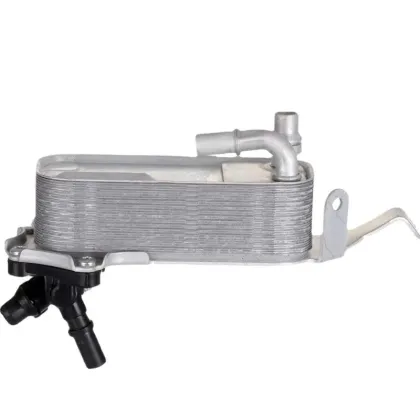
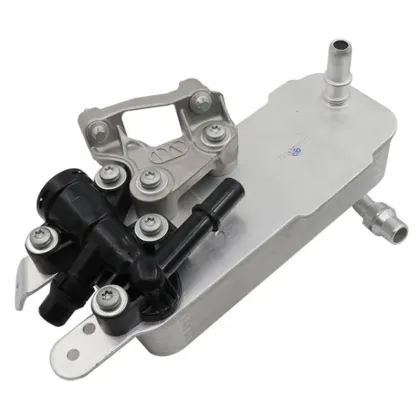
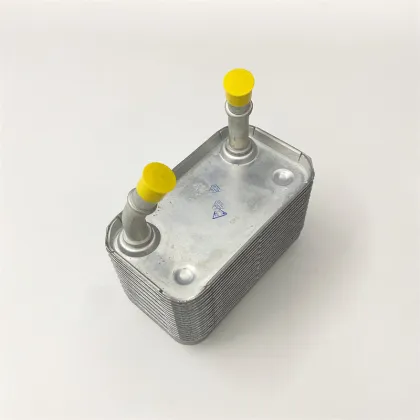
- The transmission oil cooler. Cars with an automatic transmission have a heat exchanger on or near the gearbox, where engine coolant takes heat out of the transmission fluid. It can leak fluid externally, or internally so that coolant and transmission fluid mix.
Our catalog carries the external engine oil coolers and the transmission oil coolers below. It does not carry oil filter housing gaskets.
Symptoms of each leak
- Oil filter housing gasket: oil on the side of the engine below the filter housing, oil on the serpentine belt, and a burning oil smell after driving.
- External engine oil cooler: oil drips or spray at the front of the car, an oily undertray or bumper, falling oil level and an oil level warning.
- Transmission cooler: transmission fluid drips near the gearbox or the cooler lines, coolant loss with no obvious leak, contaminated fluid, and harsh or slipping shifts.
Do not ignore an oil filter housing leak. Oil softens the serpentine belt, and a belt that frays or slips off can be pulled behind the crankshaft pulley and through the front crankshaft seal, which can cause serious engine damage. A heavily damaged external cooler is just as urgent: a punctured S58 cooler can lose oil very quickly, so stop the engine at once if an oil pressure warning appears.
How to find the source
- Let the engine cool. Hot oil, hot transmission fluid and a pressurized cooling system can all cause burns.
- Raise the car only on a lift or solid jack stands on level ground, and never work under a car held by a jack alone.
- Check the oil level, the transmission fluid condition where you can, and the coolant level, so you know which fluid is being lost.
- Remove the undertray and clean the area. Oil travels in the airflow while driving, so the lowest drip is rarely the source.
- Look at the top of the leak trail: the filter housing joint, the cooler lines and fittings, the cooler core, or the transmission cooler and its lines. Fluorescent dye and a UV lamp help on an oily engine.
- Inspect the serpentine belt for oil soaking, cracking or fraying, and replace it if it is contaminated.
On the ZF eight-speed automatic, check the cooler line connections at the transmission before you condemn the cooler. BMW service bulletin SI B24 02 15 describes fluid leaks from damaged O-rings at those connections on the E84 X1, E89 Z4 and F22, F23, F30, F31, F32, F33, F34 and F36 models with the N20, N26 or N55 engine, and calls for new O-rings and cooling lines.
Matching the part: OEM number and VIN
BMW cooler numbers depend on chassis, engine, transmission and build date. Compare the number on your part with the listing and confirm it with your VIN before you order.
- 17217572542 (17 21 7 572 542) is the right-side external engine oil cooler with bracket, listed for the F10 535i and 550i, the F07 535i GT and 550i GT, and the 640i and 640i Gran Coupe (F12, F13, F06).
- 17215A4DF50 is the external engine oil cooler listed for the 2025 M4 with the S58 3.0 L six-cylinder; other G-series M cars may use it too, so confirm by VIN.
- 17217638678 is a transmission oil cooler listed for the F10 535i, F07 535i GT, the 640i models and the F01 and F02 740i, 740Li, 750i and 750Li.
- 17218514515 (also listed as 17218607237) is a transmission oil cooler listed for the 2016–2021 230i, 330i, 330e, 430i and 530i, the 2021 M2, the 2018–2019 X3 and the 2019 X4.
- 17217593856 is a transmission oil cooler listed for the F25 X3 of 2011–2017 and the F26 X4 of 2015–2018.
- 17207500754 is a transmission oil cooler listed for the 2000–2006 E53 X5 3.0i, 4.4i and 4.6is.
Browse all BMW engine oil coolers, transmission oil coolers or the BMW catalog.
Replacement overview, difficulty and safety
Difficulty: intermediate. An external engine oil cooler usually means removing the undertray and part of the bumper or its trim, disconnecting the oil lines and swapping the cooler. A transmission cooler is reached from below and involves both coolant and transmission fluid.
- Disconnect the battery if you need to unplug sensors or remove the bumper with its lights and parking sensors.
- Catch oil, transmission fluid and coolant in separate clean pans and recycle them. Plug open lines so dirt does not get in.
- Fit new O-rings and seals on every line you disconnect. Reusing old O-rings is a common cause of a repeat leak.
- Top up engine oil to the correct level, run the engine, and check the cooler and lines for leaks.
- For a transmission cooler, refill with the fluid BMW specifies and check the level by the factory procedure, which is done at a set fluid temperature with the engine running and usually needs a scan tool. Then refill and bleed the cooling system as BMW directs.
- If coolant got into the transmission fluid, have the transmission evaluated; the fluid must be changed and the gearbox may need more than a cooler.
Genuine versus aftermarket
The coolers in our catalog are aftermarket replacements listed against the BMW OEM numbers shown, not genuine BMW parts. Genuine and original-supplier coolers have the most consistent record. An aftermarket cooler can be a sensible choice on an older car if the number matches exactly and you replace the seals and O-rings. Ask us to confirm fitment for your VIN before you order.