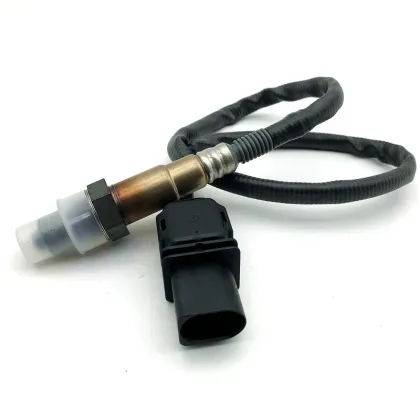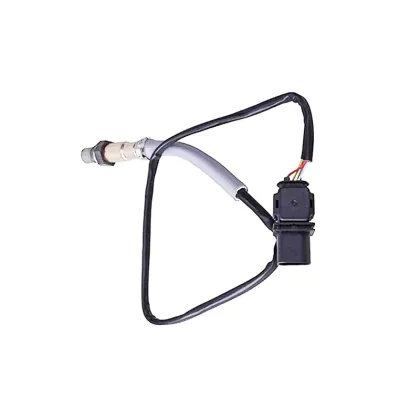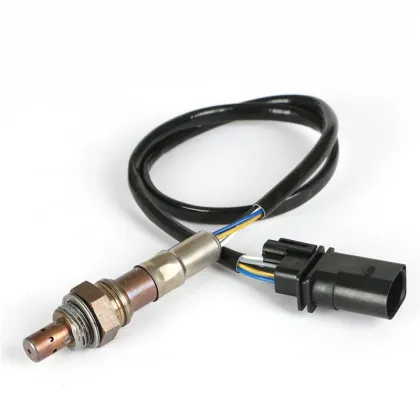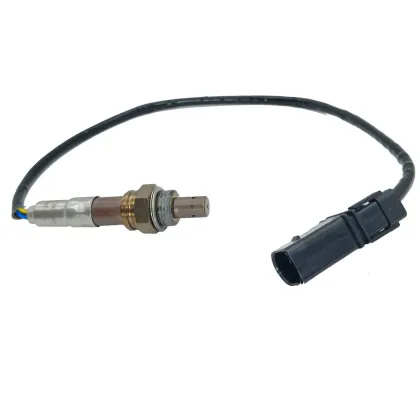
Audi Oxygen Sensor Symptoms and Fault Codes: Upstream vs Downstream
What the upstream and downstream sensors do
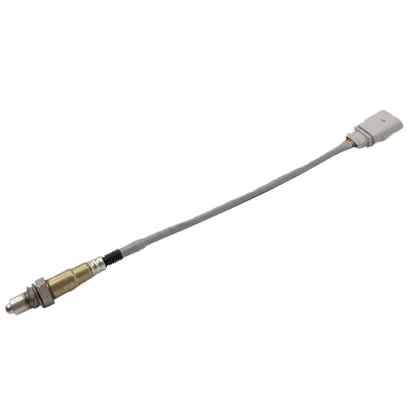
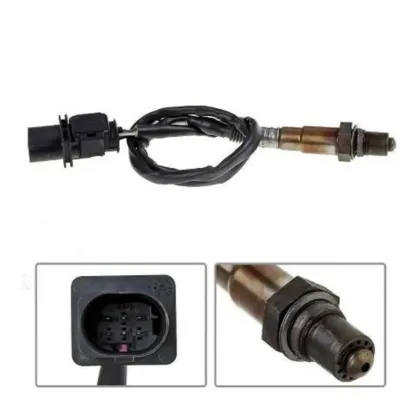
Your Audi has at least two oxygen sensors (Audi calls them lambda probes) per exhaust bank. The upstream sensor sits before the catalytic converter and measures the oxygen left in the exhaust. The engine computer uses that signal to keep the air-fuel mixture where it should be, adjusting fuel delivery many times a second. On most Audi gasoline engines from the 2000s onward this is a wideband (broadband) sensor, often called an air-fuel ratio sensor, which reports how rich or lean the mixture is over a wide range instead of just switching between rich and lean.
The downstream sensor sits after the catalytic converter. It is a conventional step-type (narrowband) sensor, and its main job is to check that the converter is storing oxygen and doing its work. It also lets the engine computer make small corrections to the upstream sensor's reading.
Four-cylinder engines have one bank, so one upstream and one downstream sensor. V6, V8, V10 and W12 engines have two banks and at least four sensors. Bank 1 is the side with cylinder 1, and Sensor 1 is always the upstream sensor, Sensor 2 the downstream one.
Symptoms of a failing oxygen sensor
- The check engine light comes on with an oxygen sensor, heater or fuel trim code.
- Fuel economy drops gradually. An aging upstream sensor often reacts slowly before it fails outright.
- Rough idle, hesitation or a fuel smell from the exhaust, usually from a faulty upstream sensor.
- A failed emissions inspection, either because of a stored code or because a readiness monitor has not completed.
- A catalytic converter efficiency code (P0420 or P0430) with no other symptoms. Sometimes the converter really is worn, but a faulty downstream sensor or an exhaust leak can cause the same code.
A bad downstream sensor rarely affects how the car drives, because it does not control the mixture. If the car runs poorly, look first at the upstream sensor and at the things that change the mixture.
Fault codes and how to diagnose
Read the codes with a scan tool, ideally one that understands Audi, and note the bank and sensor in each code. Common generic codes include P0130 to P0167 (oxygen sensor circuit faults, for example P0133, slow response, Bank 1 Sensor 1), P0030 and P0036 (heater control circuit, Bank 1 Sensor 1 and Sensor 2), P2195 and P2196 (Bank 1 Sensor 1 signal stuck lean or stuck rich), and P2270 and P2271 (the same for Bank 1 Sensor 2). Then work through it in order:
- Safety first. The exhaust and the sensors get very hot. Let the car cool before you reach under it, and support it on ramps or jack stands, never on a jack alone.
- Separate sensor codes from mixture codes. P0171 and P0174 (system too lean, Bank 1 and Bank 2) or P2187 (system too lean at idle, Bank 1) usually mean the engine really is running lean, for example from a vacuum leak, a failing PCV valve or a fuel delivery problem. A new sensor will not fix that. On direct-injection engines see also our guide to Audi high-pressure fuel pump symptoms.
- Check for exhaust leaks ahead of each sensor. A leak lets outside air in and makes the sensor read lean.
- Inspect the wiring and connectors. Look for melted insulation near the exhaust, chafed wires and corroded or loose plugs. Heater circuit codes are often wiring faults.
- Watch live data. The upstream sensor should respond quickly when you rev the engine, and fuel trims should stay close to zero. With a working converter, the downstream signal should be steadier than the upstream one. A downstream signal that copies the upstream one points to a worn converter.
- Replace the sensor named in the code only after the checks above. A wideband upstream sensor cannot be judged with a simple voltmeter, so rely on scan tool data.
Matching the sensor: OEM number, position and VIN
Audi uses many different sensors, and the same car can use different numbers for upstream and downstream, and for each bank. Read the number on the old sensor, note its position and connector, and confirm the OEM number against your VIN before ordering.
- 1K0998262L (also written 1K0 998 262 L; also listed as 1K0998262K) is a sensor with harness listed for many 2006–2017 models, mostly the 2.0 L four-cylinder A4, A5, A6, allroad and Q5, plus some larger engines. Most retailers sell it as a front sensor, but at least one Audi dealer catalog shows it in the rear position on some cars, so match the position as well as the number.
- 06E906265S is a front sensor for the 3.2 L V6 in the A4, A5, A6 and Q5 of roughly 2005–2011. The two banks can use different numbers.
- 06E906265AJ is a front sensor listed mainly for 3.0 L and 3.2 L V6 models such as the A6, A7, Q5, S4, S5 and SQ5.
- 06J906262AA is a front sensor for the 2.0 L turbo in the 2006–2013 A3 and the 2008–2015 TT and TTS.
- 06L906262F is a front sensor for the 2.0 L in the 2017–2020 A4 and the 2016–2018 A6. It replaces 06L906262D and 8R0906262E.
- 1K0998262H is a front sensor listed for the 4.2 L V8 A6 Quattro (2005–2011), the 2005–2007 A8 and the 2007 S8.
Browse all Audi oxygen sensors and the Audi catalog. Each product page lists fitment by model, year and engine.
Replacement: difficulty and tips
Difficulty: beginner to intermediate. Front sensors on four-cylinder engines are often reachable from above or below. On V6 and V8 models some sensors are tight against the transmission or the subframe and take patience. Rear sensors are usually reached from under the car.
- Work on a cool or slightly warm exhaust, never a hot one. A slightly warm sensor often comes out more easily than a cold one, but wear gloves.
- Unplug the connector first and note how the harness is routed and clipped, away from the exhaust.
- Use an oxygen sensor socket or a slotted wrench. If the sensor is seized, penetrating oil and patience are better than force, which can damage the threads in the exhaust.
- New sensors usually come with anti-seize already on the threads. If you add any, keep it off the sensor tip.
- Tighten to the torque in your repair manual, reconnect, clear the codes and drive normally so the readiness monitors can complete before an inspection.
Sensor, converter or something else?
Oxygen sensors are messengers. Before you replace a catalytic converter for a P0420, rule out exhaust leaks and a faulty downstream sensor. Before you replace an upstream sensor for a lean code, rule out vacuum leaks and fuel delivery. Oil consumption, coolant leaks into the combustion chamber and misfires can also contaminate or damage sensors, so fix the cause or the new sensor may fail early. The sensors listed here are aftermarket replacements for the OEM numbers shown, not genuine Audi parts.